Privacy / Regulation / Metadata
Advocate General says dynamic IP addresses can be personal data but deliberately provoked GDPR claims fail
In Case C-654/25 on Google Fonts, AG Szpunar also set out a two-part test for abuse of rights when individuals use automated tools to trigger GDPR infringements and seek compensation.
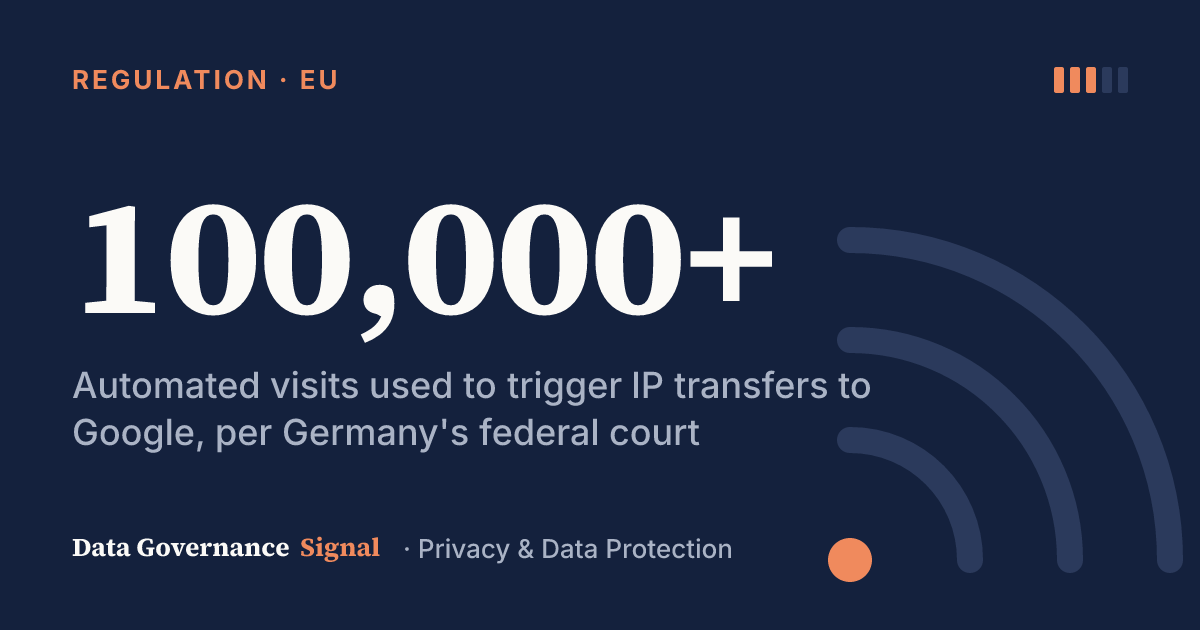
On 5 November 2026, Advocate General Maciej Szpunar delivered his Opinion in Case C-654/25, a German reference on a website that sent visitors’ dynamic IP addresses to Google in the US through a default Google Fonts configuration. According to the German Federal Court of Justice, the claimant used automated tools to trigger such visits more than 100,000 times and then sought compensation.
The AG said a dynamic IP address can be personal data for a recipient with means reasonably likely to identify the person, and indirectly for the website operator if it knew or should have known of those means. On Article 82 GDPR, he said no non-material damage arises where someone knowingly provokes infringements in an automated, repeated way to obtain compensation. Abuse of rights needs an objective and a subjective element; financial gain need only be the primary aim.
The Opinion is not binding. The CJEU will now deliberate.
Editor’s note: This article relies on a law firm’s blog report of the Advocate General’s Opinion, which is available only in French.
Why it matters
If the Court follows the Opinion, website operators could be treated as processing personal data whenever an embedded third-party service can identify visitors from IP addresses, so data inventories and records of processing should capture IP data flowing to embedded fonts, scripts and similar components. The compensation reasoning may help organisations facing serial, automated GDPR damages claims, but it does not cure the underlying transfer; privacy teams should still review default configurations of third-party web resources that send data outside the EU.
Status: Non-binding opinion. CJEU judgment still to come
Sources
Was this useful?
Thanks. What was the problem?
Thank you — this helps us choose what to cover. If you spotted an error, please tell us what it is.
Prepared with AI assistance and reviewed by the editor before publication. Spotted an error? Tell us — see our editorial policy and methodology.
Governance areas
Legislation tracker
- GDPRApplies · 12 stories
Institutions
Who should care
- DPO
- Legal & compliance
- Data stewards
- Web and marketing technology owners