Privacy / Regulation / Master Data
CalPrivacy advances CCPA amendments requiring opt-out signals to be honoured before tracking cookies fire
Draft text extends opt-outs to linked pseudonymous profiles, bans cookie syncing after a GPC signal and adds signal-specific request metrics for large data handlers. A 45-day comment period is next.
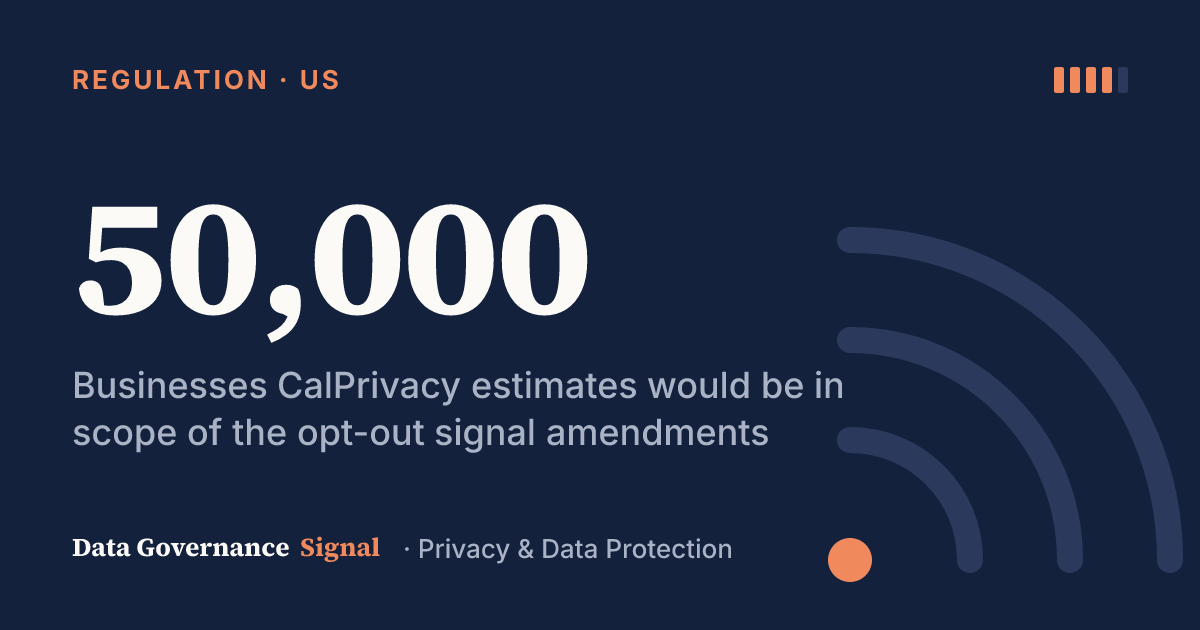
California’s privacy regulator, CalPrivacy, voted unanimously on 6 November 2026 to advance proposed amendments to its CCPA regulations on opt-out preference signals such as Global Privacy Control (GPC). According to Hunton, the agency estimates that about 50,000 businesses would be in scope and says the changes largely clarify existing duties rather than add new ones.
The draft text states that a business letting advertising cookies or pixels fire before its consent or tag management tools check for a GPC signal has not complied “as soon as feasibly possible”. Opt-outs must extend to pseudonymous profiles, including devices linked through matching techniques such as fingerprinting, and third-party cookie syncing must be blocked. Businesses already subject to metrics reporting, including those handling data of 10 million or more consumers a year, would have to count signal-based opt-outs separately.
A formal 45-day public comment period is due to open; the sources give no date.
Why it matters
The draft turns opt-out handling into a data lineage and identity-resolution problem: if your organisation links browsers and devices into a pseudonymous or master profile, a single GPC signal must propagate to every linked record and downstream third party. Tag and consent management sequencing becomes a compliance control, since tracking that fires before signal detection is treated as non-compliance. Large data handlers will also need request logs that record the channel each opt-out arrived through, so that annual metrics can be produced.
Status: Proposal. formal 45-day public comment period yet to open
What to check
- Test whether advertising and analytics cookies, pixels or cookie-syncing scripts on your websites fire before your CMP or tag manager has detected a GPC signal.
- Map where browsers and devices are linked into pseudonymous or customer profiles and confirm that an opt-out received on one is applied to all linked records and notified to third parties.
- If you fall under the CCPA metrics reporting rule, confirm that your request-handling system records whether each opt-out came from a preference signal.
Sources
Was this useful?
Thanks. What was the problem?
Thank you — this helps us choose what to cover. If you spotted an error, please tell us what it is.
Prepared with AI assistance and reviewed by the editor before publication. Spotted an error? Tell us — see our editorial policy and methodology.
Governance areas
Legislation tracker
- CCPA RegulationsApplies · 2 stories
Institutions
Who should care
- DPO
- Legal & compliance
- Data stewards
- Marketing technology owners