AI Governance / Regulation / Metadata
FPF urges Colorado to narrow ADMT 'de minimis' test and tie developer disclosures to deployer duties
In comments on the Colorado Department of Law's 6 October interim draft rules, FPF asks for two of six human-involvement factors to be dropped and for developers to supply version and output-data details.
The Future of Privacy Forum (FPF) filed comments on 26 October 2026 in the Colorado Department of Law’s rulemaking for the Automated Decision-Making Technology Act (SB 26-189). The Act replaced the Colorado AI Act and takes effect on 1 January 2027.
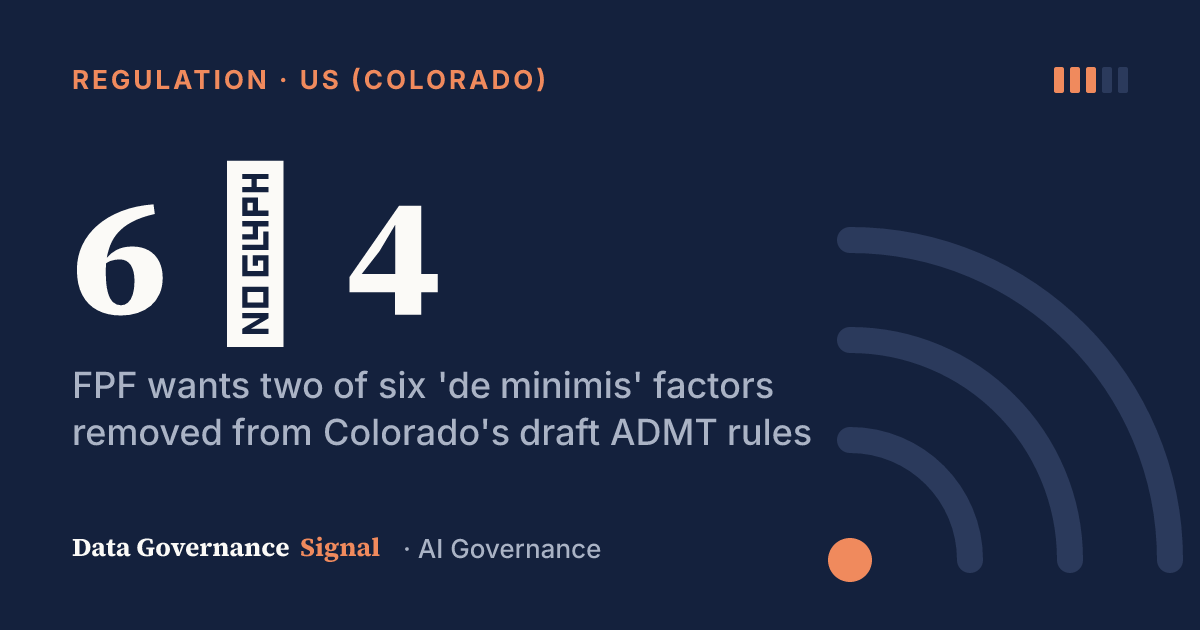
The interim draft lists six considerations for deciding whether an ADMT output was a ‘de minimis’ factor in a consequential decision. FPF wants to keep the four on human review, independent analysis, expertise and authority, which it says mirror California and existing Colorado Privacy Act rules. It would drop the factors on organisational policies and on the volume or complexity of personal data, treating policies as rebuttal evidence under proposed Rule 6.1(B).
FPF also asks that developers give deployers enough documentation to meet their obligations, including system name, version and the categories of outputs generated, plus timely notice of material updates. The Department has not yet finalised the rules.
Editor’s note: This article relies solely on the Future of Privacy Forum’s own blog post and comment letter, setting out the views of a policy organisation.
Why it matters
If FPF's approach is adopted, whether a system is in scope will turn on evidence of what human reviewers actually did, so deployers will need contemporaneous records of review, expertise and decision authority, not just policy documents. The proposed developer disclosures — model name and version, the scores, classifications and inferences a system generates, validated populations and known risks — map directly onto AI inventory and metadata fields. Because the draft already requires deployers to disclose a system's version number, procurement and data teams should ensure vendor contracts and catalogues capture version changes.
Status: Consultation. Interim draft rules under review; Department has not finalised them
Key dates
- Colorado Automated Decision-Making Technology Act (SB 26-189) takes effect
Sources
Was this useful?
Thanks. What was the problem?
Thank you — this helps us choose what to cover. If you spotted an error, please tell us what it is.
Prepared with AI assistance and reviewed by the editor before publication. Spotted an error? Tell us — see our editorial policy and methodology.
Governance areas
Legislation tracker
- Colorado ADMT ActAdopted · 2 stories
Who should care
- AI governance lead
- Legal & compliance
- DPO
- Data stewards